
Quick update with cool news! The science fiction podcast Escape Pod will be presenting a reading of my novelette "Pen Pal" in a few weeks. They do terrific work with narrative readings of science fiction stories, and I'm looking forward to hearing the characters in this story come alive. Stay tuned for details.
Sunday, September 25, 2022

Saturday, July 17, 2021
Merlin SoundID
Overview of a brief field test of the Merlin SoundID app
I downloaded the Merlin app to my iPad and installed the SoundID module. I tested SoundID identification in a bird community typical of Willamette Valley residential areas in July; birds were reasonably vocal but in general not actively singing at this stage of the breeding season. I am familiar with all of the bird species expected at this location. This site has light to moderate ambient noise (traffic and machinery) - generally this is not an issue but it may briefly interfere with audio detections. SoundID recommends working with audio clips of no more than 2 minutes in length. For this test I conducted five 10-minute point counts - during each of which I collected five sequential 2-minute audio clips in SoundID. During these counts I allowed Merlin to access iPad location information, so that suggested identifications were informed by appropriate geographical location. During each point count I recorded all birds that I detected, whether they were identified visually or by sound, and estimated numbers of each species. If Merlin provided a species identification on any of the five audio clips during a count, I scored the species as identified by SoundID. SoundID identifications that I did not myself detect during the point count were noted in the checklist comments.
Each point count was recorded as an eBird checklist:
https://ebird.org/checklist/S91876620
https://ebird.org/checklist/S91878345
https://ebird.org/checklist/S91880634
https://ebird.org/checklist/S91887506
https://ebird.org/checklist/S91887743
Summarizing species detected, with total number of counts on which each was confirmed to have occurred, broken down by three identification methods:
Species #Counts Visual Heard SoundID
Eurasian Collared-Dove 4 3 3 2
Vaux's Swift 3 3 1 1
Anna's Hummingbird 5 3 5 1
Turkey Vulture 2 2 0 0
Cooper's Hawk 0 0 0 1
Great Horned Owl 0 0 0 2
California Scrub-Jay 3 2 2 0
American Crow 3 0 3 1
Violet-green Swallow 3 1 2 2
European Starling 2 2 2 0
Cedar Waxwing 1? 0 0 1
Evening Grosbeak 1 1 1 0
House Finch 3 3 3 2
American Goldfinch 4 2 3 2
Pine Siskin 0 0 0 1
Finch sp. 2 1 1 0
For the species detected only by SoundID during a count, I reviewed the audio clip to assess whether I could identify the call. The Great Horned Owl and Cooper's Hawk identifications appeared to be concurrent with Eurasian Collared-Dove calls. The Pine Siskin identification appeared to be concurrent with a European Starling call; the Cedar Waxwing identification was a high-pitched whistle that might have been correctly identified but was likely a European Starling call.
Total number of confirmed species x count detections was 35, including two finches not confirmed to species. Of these, 23 were visually detected, 26 were heard, and 12 were correctly detected by SoundID. In addition, there were 4 species x count detections by SoundID that appeared to be incorrectly identified, and one (Cedar Waxwing) for which the accuracy of the identification was undetermined.
My thoughts:
1) I enjoyed using this app. Even though the successful identification rate was fairly low, it was impressive that in many cases SoundID successfully picked up an identification within a few seconds. Indeed, in a few cases where I was not paying full attention, the ID popped up slightly before I had mentally processed a sound. Because the app can often provide nearly real-time feedback and does not get distracted, this could be a useful training tool to help with learning bird identification by sound.
2) The accuracy of identification is by no means adequate to be relied upon for a comprehensive bird list or to document rarities. Nonvocal species like Turkey Vultures will of course never be picked up. Moreover, vocalizations that are nearby and loud are much more likely to be detected; in several cases even where a species was successfully ID'd, the birds had been identifiably calling at a moderate distance for several minutes before SoundID successfully made an identification. Possibly a better microphone system than the iPad default would allow more species to be detected. The rate of incorrect identifications was significant, so using the system even for learning purposes certainly needs to be tempered with more than a grain of salt.
3) Evidently starlings are hard! These five point counts included 20 minutes of loud and actively communicating social starlings, about 20 meters away, but SoundID never provided a European Starling ID. Since their vocalizations are so diverse, this might be unsurprising, but it was a significant miss.
4) On other trials where I set the iPad to not allow Merlin access to location information, SoundID did the best it could but was nowhere near as realistic. (A notification did pop up indicating that the identifications did not incorporate location info and might be inaccurate). A wide variety of unlikely North American species were proposed, including Common Redpoll, Flammulated Owl, American Avocet, and Yellow-crowned Night Heron. Enabling location info is necessary to give a fair test of the system.
Tuesday, March 9, 2021
Ten Bird Commandments
Having been listening to the soundtrack for Hamilton this past week, I got a brainstorm for alternative lyrics to "The Ten Duel Commandments." If you don't mind wading through a thicket of birding in-jokes!
(Here's the original!)
https://www.youtube.com/watch?v=m7iHmuco_zo
One, two, three, four, five, six, seven, eight, nine!
It's the Ten Bird Commandments!
Number One:
The challenge – identifications.
You'll need your sharpest eyes, plus a bunch of patience.
Number Two:
In your pack, have a Sibley (the Second
Edition) for when field marks are reckoned.
Number Three:
Hit the hotspot when the rain clears.
Binoculars are nice
If a Code 5 rarity appears.
Also train your ears, catch the flight calls fast.
Don't Just Rely On Expensive Glass!
Number Four:
If you can't clinch ID, that's all right -
Time to post to OBOL, get some twitchers on site.
Everybody scans to the best of their ability;
Some birdseed as a gift is a marker of civility.
Five:
Start before the sun is in the sky.
Chorus song is high, spare an eye to spy!
Number Six:
Leave a note on the eBird site.
Make your case airtight.
Pray reviewers will confirm it's right.
Seven:
Confess you did
Not get a photo but
It might still be amid
That other flock of butterbutts.
Number Eight:
Last chance to equivocate!
Send Dave Irons in, maybe he can set the record straight.
--On the third branch?
--That's the bird. --Sure,
But you can't see projection from that perch. --Heard
It call, somewhere over in that birch. --Bird's
Dropped down. --If we had another searcher...
--Hang on! That back is too gray. You see, an Acadian
won't fit the facts.
--Okay... It's “Empidonax”.
Number Nine:
Next migration time, it might transpire.
Finally start a big year, aim much higher.
Count 1, 2, 3, 4, 5, 6, 7, 8, 9
Sand Martins on the wire!
Thursday, November 12, 2020
Lesser Angels
[spoilers below for The Translator!]
In John Crowley's novel The Translator, during the early 1960s the exiled Russian poet Innokenti Isayevich Falin has come to teach at a Midwestern university. His student Kit finds that peculiar circumstances surround him, inexplicably and persistently. And then one night she happens to see him walking across campus, and follows him, but:
...she slowed uncertainly; she could see down all the lighted paths, he couldn't have gone far.
He was gone, gone entirely, vanished.
She walked on toward the library, feeling an Alice feeling of having been put in the wrong by a being who didn't follow the laws of physics. Then she found she was walking right toward him: he stood before the library, and he was talking to a slim dark woman, or rather listening to her talk, she seemed distraught or upset somehow, she talked and shook her head and almost seemed to tremble: and then as Kit came close, almost too close, unable not to, the woman pressed her cheek against his coat.
Only one paragraph, and this woman never reappears in the story. But Crowley is not one to be sloppy about leaving threads dangling in his narrative.
Who is she?
The twisting shadow of the Cold War moves over the life of this little college campus. At the height of the Cuban Missile Crisis Falin... vanishes. The manuscripts of his poems are mysteriously lost. But the world edges back away from war, and life persists.
Many years later Kit speaks to her father of it:
"I think that back then, when he came to this country, there was a struggle going on between the angels of the nations, his and ours; and that in their anger and their fear, those angels came to destroy the world...
"But no, of course it didn't happen," Kit said, and she rose up and went to the window, as though to release her thought or her soul that way. "It didn't, it should have but it didn't. Because the lesser angel of one nation interceded. On our behalf. He made an offer; he offered himself."
"The lesser angel," George said. "The lesser angel."...
"The lesser angel," she said. "Every nation has one: an angel who is all that the greater angel isn't. Who can weep if the nation's angel can't; or laugh if it never does; who is small and weak and powerless, like us. Except this once. Because the lesser angel could say: Take this as a sop to your anger. And it worked...
"It didn't have to be much. It wasn't much. It was only the thing most precious to him. What would destroy him to lose. His soul."
"They have souls?"
"His self. His life." A sheaf of papers, yellow American copy paper, the rough uneven lines of Russian words typed on the Undervud. "They couldn't refuse that."
"They couldn't."
"They couldn't. They can't. It's how they are."
And if Soviet Russia had a lesser angel, the animating spirit of what was not the gray empire of the Politburo and the KGB and the gulags; I take it that America had one as well.
And that she remains.
Thanks to Ibram Kendi for his article this week in The Atlantic, A Battle between the Two Souls of America, which brought this back to my mind.
Monday, October 12, 2020
Geese
For three days toward the end of September,
Crack open your window sometime at night, and
Then listen if you can remember.
Flocks hidden by cloud in the starless skies.
Only the clamor of high yelping cries
Reveals the swift whitefronts in far-coursing flight, and
If you miss them, the next week they’re gone.
From Gulf Coast marshes white flocks now ascend with
Black wingtips in motion. Loud vees assemble,
Surge northward across thawing land, with
Their way bending left at the Arctic coast,
Drawn by the memories, bright in their host,
Of nests and soft grasses, the island of Wrangel.
Chanting one to the other, course on.
Monday, July 20, 2020
On Behalf of Athena
All of a sudden, bang! bang! bang! goes three or four guns - the men had slipped around through the woods and come in from behind without their horses! The boys jumped for the river - both of them hurt - and as they swum down the current the men run along the bank shooting at them and singing out, "Kill them, kill them!" It made me so sick I most fell out of the tree. I ain't a-going to tell all that happened - it would make me sick again if I was to do that. I wished I hadn't ever come ashore that night to see such things. I ain't ever going to get shut of them - lots of times I dream about them...


When I got down out of the tree I crept along down the river bank a piece, and found the two bodies laying in the edge of the water, and tugged at them till I got them ashore; then I covered up their faces, and got away as quick as I could. I cried a little when I was covering up Buck's face, for he was mighty good to me.*
This spring I spent a lot of time with Schiller's ballad The Cranes of Ibycus (best ever [and possibly only!] German Romantic/Ancient Greek murder mystery in verse). In the pivotal scene, a rowdy Greek audience crowds into an open theater to watch a performance. On the stage, singing their song of vengeance, is the chorus of Furies, torch-bearing, gaunt, their heads crowned like Medusa's with writhing serpents. By the illusion of the theater they seem to stand at a scale larger than human, and the audience half-forgets that they are actors as they channel their divine role. And under that spell the relentless pursuit of vengeance to which the Furies dedicate their song suddenly has unexpected consequences in reality.
The play being performed here is, presumably, Aeschylus' The Eumenides, climax of the Oresteia trilogy. Right now the whole story's worth a closer look.
As the Greeks assemble their fleet to embark for the siege of Troy, the goddess Artemis sends unfavorable winds and prevents them from sailing. A seer reveals to their war-leader, Agamemnon, that the only way to appease Artemis is for him to sacrifice the life of his eldest daughter, Iphigenia. At length he agrees, and does so. This act is to mire the fate of his entire family in a recurring cycle of revenge for many years to come. But the winds shift, and the Greek fleet sets sail.
Ten years later, when Agamemnon returns from the Trojan War, his wife Clytemnestra stabs him to death in his bath in revenge for their daughter's killing. Years later again, Orestes and Electra, the surviving brother and sister of Iphigenia, agree that by Apollo's order Clytemnestra must also die for murdering their father. Orestes kills his mother, and her ghost incites the Furies to hunt him down and wreak their vengeance.
The Furies, the old goddesses of retribution and vengeance, track down Orestes and demand that Athena and Apollo give him over to them. Instead, Athena yields the judgment to the people of Athens, instituting the first-ever trial by jury. The Furies and Apollo each make their cases to the jury for prosecution and defense. The jury votes: tied at six to six, so Athena casts the deciding vote in favor of Orestes.
So Orestes goes free. The Furies have not won their victory. But Athena tells them that they have not lost, either. By putting their drive for vengeance in subordination to the process of law, they gain a permanent place of honor in the city, and the right to dispense blessings to its people. The Erinyes, the Furies, have become the Eumenides, the Gracious Ones; and the city of Athens becomes the stronger for it.
Anger is natural. Anger at someone who has hurt you; has hurt your friends; your family. So it's easy to fall into a cycle of retribution. Nobody is immune to that risk. Not in Greece, not in America. When Huckleberry Finn stayed at the house of the Grangerfords they were hospitable, kind hosts to him - well-mannered, keeping a lovely home, loyal to family, generous to strangers, raising quirky and likable kids. None of that meant they wouldn't let their feud with the Shepherdsons drop them right into the same fate as Agamemnon and Clytemnestra.
And vengeance propagates itself over generations, like an ivy-vine grasping out for one tendril-hold after another - Iphigenia, Agamemnon, Clytemnestra, Orestes, some Grangerford who killed some Shepherdson. Or maybe it was the other way about, who knows by now? Young Buck and Joe. A big stem of ivy choking off a maple can easily get as thick as your arm. Looking at the process analytically, you'd have to say it's got what it needs to keep itself going for a good long time. That's what the Oresteia is all about - using the new idea of impartial law to break the cycle and give a new generation a chance to live fresh lives without the weight of the past dragging them down.
Of course, this all depends on the rule of law staying... lawful. Due process. Equal protection under the law. Right to a fair trial. As Athena says, the agreement's a two-way street, and those who enforce the law have particular obligations that had better be met. Otherwise you're liable to end up back with the Furies. And in the end that doesn't work out well for anyone.
Now for the first time, people of Attica,
Judge a murder-case, and hear my words.
For ever from this time for Aegeus' children
This court will sit for justice to be heard,
On Ares' hill, this Areopagus...
So in this place will reverence for the law
And kindred fear of doing injustices
Restrain the people of Athens, day and night
Provided they themselves do not pollute
With evil influence their justice code.
Would you quench your thirst in Justice's healing stream?
Then do not foul it - keep it flowing clean.**
Athena put a lot of work into this project. Let’s not mess it up.
*Huckleberry Finn, by Mark Twain. Chapter 18
**The Eumenides, by Aeschylus. Translation by Timothy Chappell
Παλλας Άθηνα
παρθένος γλαυκῶπις
Pallas Athena,
Gray-eyed maiden.
Άτρυτώνη
Πρόμαχος
Tuesday, June 30, 2020
Dispatch from the Viewing Blind
First of all, I can assure you that we are at very little risk here within. Although the dinosaurs move freely about the exterior of the blind, I am confident that its rugged construction is entirely adequate to keep them at bay. The viewing portals are composed of a sturdy thickness of glass, fully transparent and yet strong enough to repel any conceivable theropod assault. Furthermore, the walls are even stronger by far, entirely proof against any dinosaurian attempt to enter. And so is the roof, in case any of the creatures find their way up to the top. (Occasionally they do, of course; there isn't any practical way to prevent it.) Once in a great while we will hear one hammering with sharp blows against the upper wall, or observe an impact as an over-active smaller theropod accidentally caroms against one of the glassy portals. But the truth is that they largely ignore us, being intent upon their own business, and have never made any determined effort to gain access to the interior. For our part, we are perfectly comfortable here inside, and can readily look out in all four directions to view the activities of the local denizens.
I can report that the dinosaur lineages that survived the unfortunate incident with the asteroid some millions of years ago are once again diverse and thriving.

The blind is surrounded by a low sward of graminoid monocotyledons, upon which the saurians prance and stride and make their displays. On one side grow a couple of Betula trees and other large woody dicots, their drooping and feathery foliage sometimes rustling and swaying in the balmy breezes of this era. On the other side there is a small pool surrounded by flat stones and bearing a luxuriant growth of aquatic plants - Azolla, Typha, and Eichhornia. The last has begun to bloom - flowering plants are indeed abundant in the landscape of this age - and its pale violet blossoms present a weird and hypnotic aspect against the pool's murky depths. In the heat of the day we will often see the dinosaurs dart in, peer cautiously about, and stoop to drink from its waters.
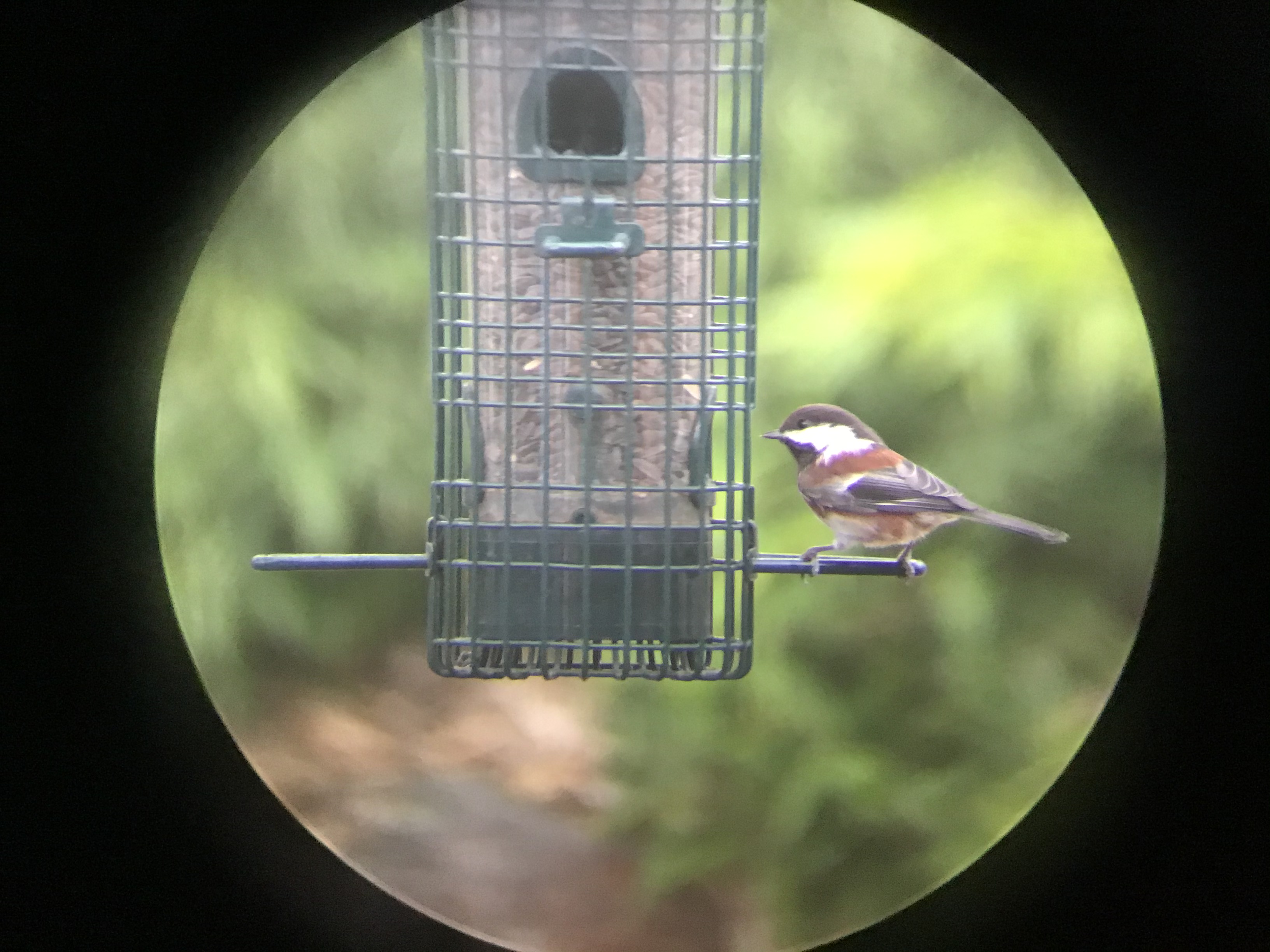
From a jutting limb of one of the dicot trees I have suspended a cylindrical container, pierced at several points on its circumference, and filled it up with the dry blackish fruiting bodies of a variety of Helianthus. Many of the dinosaurs find these delectable, and this station has served to attract them to a place where we can easily observe their posturing and quarrels. Just now I have been watching a pair of Haemorhous that have placed themselves on either side of the feeding station, monopolizing it, and are slowly and deliberately shucking and consuming the fruits. No other dinosaurs seem inclined to try to displace them before they have eaten their fill. The scientific name Haemorhous comes from the Greek, meaning "bloody-rumped" - and one might be forgiven for conjuring up images of horrific battles and lacerations, sanguinary in victory or defeat. And no doubt they would be capable of rage if sufficiently provoked. But the reality is that the name refers to their natural coloration, the male being handsomely streaked with red upon the rump and the breast. His mate, calmly feeding beside him, is brownish and nondescript. At last they depart, leaving a scattering of brittle husks upon the ground.
As if they have been watching and waiting for their opportunity, more theropods dash in one by one, quickly seize a fruit in their mandibles, and make their getaway to some sheltered patch of foliage where they can make their meal in safety. In rapid succession I see the smaller Sitta and two species of Poecile, here and gone again in a moment. Then new arrivals appear on the scene, dwarfing them all. Striding across the greensward, oblivious to the littler dinosaurs, comes a dark squadron of half a dozen Sturnus. These saurians ignore the Helianthus fruits, but scan and peer downward into the graminoid turf as they walk, periodically stabbing to seize some hefty invertebrate larva at their feet. Blocky in stature, glossy black with bright spangles, single-minded, they quarrelsomely call out to each other with grating cries as they bowl along through the vegetation.
Through the opposite portal I hear the raucous call of a Streptopelia, and another giving its low, rhythmic, hooting cry in response. A pair of them are walking toward the pool - smooth-featured, strangely serene in bearing, their bodies subtly tinted in pale-brown and dove-gray shades of pastel. One stands watch as the other balances on a stone and bends down to drink. Unlike most other saurians, the Streptopelia need not pause to tip its head back after every mouthful of water and swallow - it dips its curious muzzle into the pool and drinks continuously until it has slaked its thirst.
In this timeless age it is easy to think that the natural world is unchanging, but of course it exists in its own place in history and one can see transient changes if one looks. Twenty years prior the Streptopelia was unknown in this region. Formerly they (like the Sturnus) had been native to an entirely different continent, placed by chance of plate tectonics on the opposite side of the planet, until some strange accident brought a few of them to the far edge of this one. But they found their new home well to their liking, prospered, bred, and swiftly multiplied; now their call is a common sound along the ridge where we have placed this blind. When they arrived here I wondered with some concern whether their smaller cousins the Zenaida might soon find themselves outcompeted and pushed out. But so far I admit that they seem to be managing a successful coexistence.
There is a harsh cry and a blurred blue form barrels toward the pond. Startled from their drink, the Streptopelia leap up and are routed into sudden flight. The winner of the confrontation takes a victory lap and comes back to stand triumphantly atop the poolside rocks, looking irascibly about for other challengers. This is an Aphelocoma, who has apparently claimed personal ownership of this pool and rarely allows an intruder to linger for very long before swooping in to drive it off. Noisy, curious, watchful, and intelligent, he and his boisterous family are never far away.
Smallest of the dinosaurs, but more pugnacious yet, are the trochilids - Calypte and in certain seasons a few Selasphorus. Near one of the blind's portals I have placed a glass bulb filled with sugary liquid, and nearby they hover, thirsty for its sweetness but ever-watchful for intrusion by others of their kind. Their movements invisibly quick, bright scarlet iridescence flashing from their throats in the sunshine, they chitter, dart, leap in an instant to joyful battle. Faster than the eye can follow, they dodge, parry, calculate and recalculate their tactics of aggression and defense with blazing speed in a splintered second; and then mysteriously and bilaterally declare a sudden truce to rest and drink side by side.
The dinosaurs squawk and squabble, but rarely seem to bring one another to much actual harm. Yet once in a while I hear angry cries from a family of Sturnus or Tachycineta, and look out to see them mobbing a true predator until it gives up the hunt - yesterday it was an accipitrid speeding off amid the trees, perhaps Accipiter striatus. They cry out the alarm to give their young the warning. And it gives me a reminder that there are matters of life and death at play, here as well.
In recent months I have been confined within this blind more than I had expected, to tell the truth. But I am glad to have the opportunity to observe at close range the strange and wonderful creatures that inhabit this age of the world.
I am more and more tempted to venture out and mingle among them.
It is just hard to know whether it is safe.
Subscribe to:
Posts (Atom)